
How Spanish Fork Residents Are Found
There is no single official list of every person in Spanish Fork. Each custodian records a different relationship. The Utah County Assessor and recorder connect names to parcels and recorded instruments. Utah Elections can help a voter check a personal registration record, but its public and private fields are controlled by Utah law. Utah courts index cases, not a universal list of residents. Libraries, archives, cemeteries, and newspapers add historical context.
Use the strongest fact in hand first. An address is usually the cleanest start for a parcel search. A full name can open the assessor name form, the court party search, a cemetery search, or a business or license record. An old date changes the route again, because the recorder has handwritten indexes before January 1978 and the state archives hold older municipal and court material.
- Normalize the Spanish Fork address, city label, and ZIP, then locate the parcel in the Utah County Parcel Map.
- Copy the parcel serial and compare the assessor result with the site address and owner mailing address.
- Use the recorder index for principal parties, document type, legal description, recording date, and image links.
- Use a voter, court, vital, cemetery, or license source only for the narrow record question it is built to answer.
- For older material, check the library, Provo county-history resources, Utah Archives, or FamilySearch and save the series or page reference.
Spanish Fork Records Offices
Most records tied to a Spanish Fork parcel are kept at the Utah County level. Provo is the county seat. The Utah County Recorder is at 100 E Center St, Suite 1300, Provo, Utah 84606, and lists 801-851-8179 and recorder@utahcounty.gov. The Utah County Clerk Elections office is at 100 E Center St, Suite 3100, Provo, Utah 84601, with 801-851-VOTE and elections@utahcounty.gov. Spanish Fork city records have a separate route through City Hall at 40 S Main, Spanish Fork, Utah 84660, with records@spanishfork.gov and 801-804-4530 for the city recorder.
Use the named custodian, not the city name alone. The county recorder handles deeds, abstracts, plats, and other recorded land documents. The county assessor and GIS services handle parcel information and map context. City Community Development uses CitizenServe for permits. City police records have their own request rules. A written GRAMA request should identify the record, date range, parcel or case number, and desired format.
Start With a Spanish Fork Parcel
The county parcel viewer accepts an address or common place name with autocomplete, a serial or book-page reference, an owner name, a PLSS section, or a city. Directional and street abbreviations such as N, E, St, Blvd, and Wy are supported in the address tips. A serial may appear as 123456789, 12:345:6789, 12 345 6789, or 12-345-6789. An owner search can be slow when many names match, so select the intended name before using Zoom to.
Parcel results are an index and map aid. They can show an owner name, serial number, tax area, years valid, and property address or city. The assessor landing page also points to property details, subdivisions, taxes, appraisals, serial history, and aerial imagery. That information can locate the record family, but it is not a title opinion. The recorder expressly says staff do not perform title searches or give legal advice.
| Situs address | The physical property location, held in fields such as SITE_STREET_NAME, SITE_CITY, and SITE_ZIP5. |
|---|---|
| Owner mailing address | The address used for owner correspondence, held separately in fields such as OWN_FULL_ADDRESS and OWN_ZIP5. |
| Parcel serial | The stable county reference that can bridge assessor, map, tax, and recorder work. |
| Historic parcel date | The date a parcel entered the online parcel system, not the date a deed was recorded. |
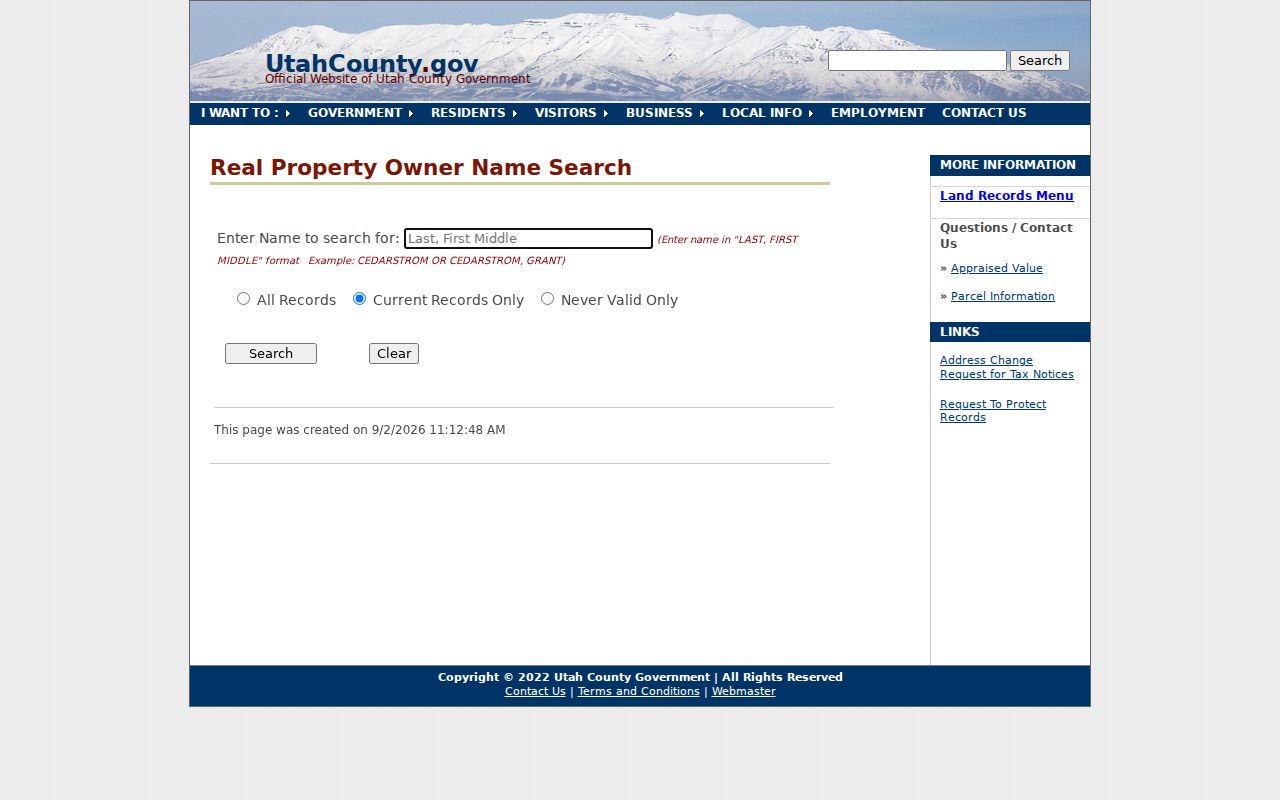
Search-field check: the Utah County name form asks for “Enter Name to search for,” uses the format LAST, FIRST MIDDLE, and offers All Records, Current Records Only, and Never Valid Only. Search and Reset are the visible controls.
What County Results Actually Show
A name result can place a person or organization beside a parcel, but the label matters. The inspected county result format includes owner name, colon-delimited serial number, tax area, validity years, property address, city text, and Next or Last pagination. Those fields support a lead. They do not prove that a named owner lives at the site, that every household member is listed, or that a mailing address is the same as the property location.
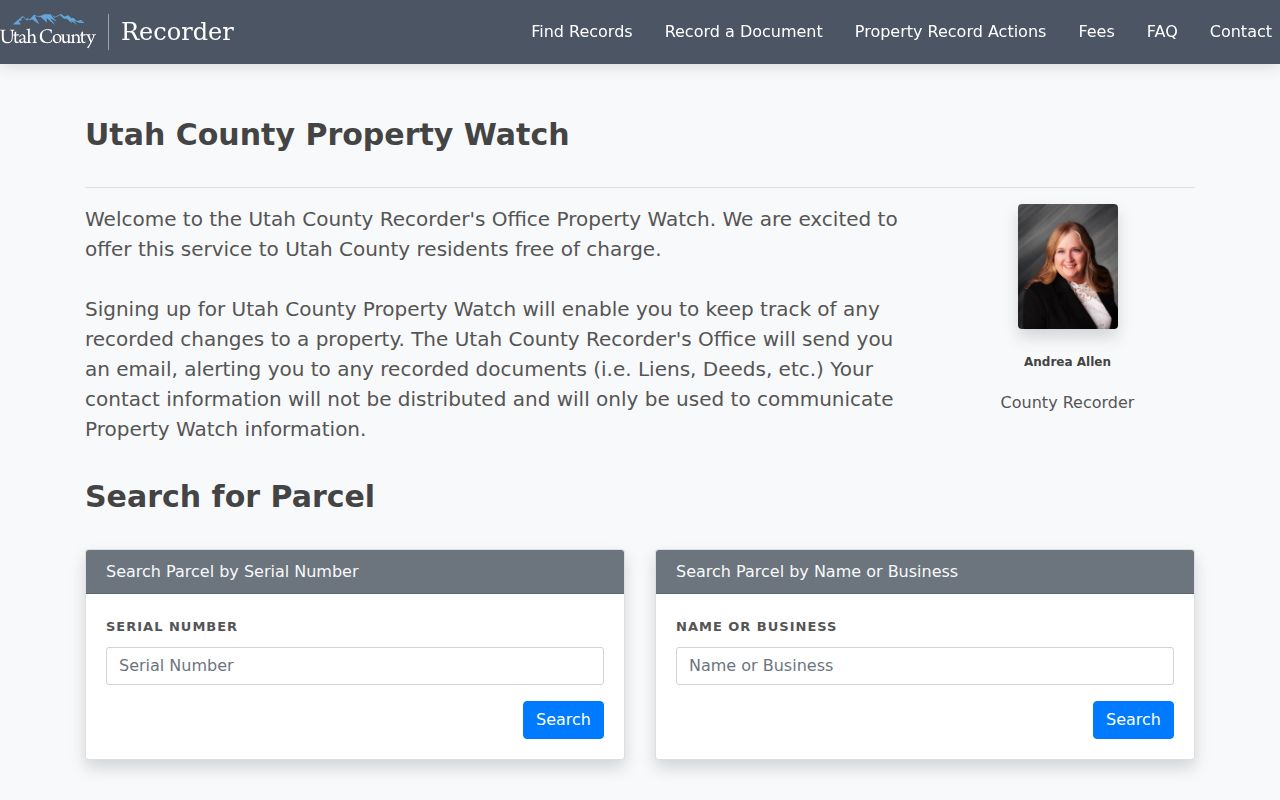
For a stronger match, carry the serial into the map and then into the recorder search. Compare the property address with the legal description. If the question concerns taxes, use the Treasurer and the tax year. A delinquent-tax line describes a parcel or account condition, not a person’s character or current presence. Property Watch can send notices about recorded changes, but it is a forward-looking alert and not a deed history or fraud guarantee.
The Utah County Property Watch service shows the subscription route for recorded change notices.
Record discipline. Save the query date, serial, direct record link, and document number. A portal can change its rows, fees, pagination, or image access after the search.
Current Spanish Fork Record Sources
The most useful directory-like sources have different scopes. A parcel roll is about land. A voter record is about registration. A court case is about a filed matter. A cemetery entry is about burial information. A business or license file is about an entity or credential. Use the exact source term in notes so a party, registrant, owner, decedent, or licensee is not casually relabeled as a resident.
| Source | What It Can Show | Custodian | Access Route |
|---|---|---|---|
| Property and parcel index | Owner, serial, tax area, site address | Utah County Assessor/GIS | Web search |
| Recorded-document index | Principal parties, recording dates, images | Utah County Recorder | Web, counter, mail, GRAMA where applicable |
| Voter self-lookup | Registration details for the voter’s own check | Utah Elections | State lookup |
| State court case index | Public case history and documents within scope | Utah State Courts | Xchange, courthouse terminal, clerk |
| Cemetery and obituary indexes | Burial, family, death-date, and newspaper leads | Spanish Fork, Provo Library, Archives | Online search and staff fallback |
For the one-person workflow, the Spanish Fork resident lookup page is the natural next step. For a whole street, use the address-led record chain in the street directory lookup.
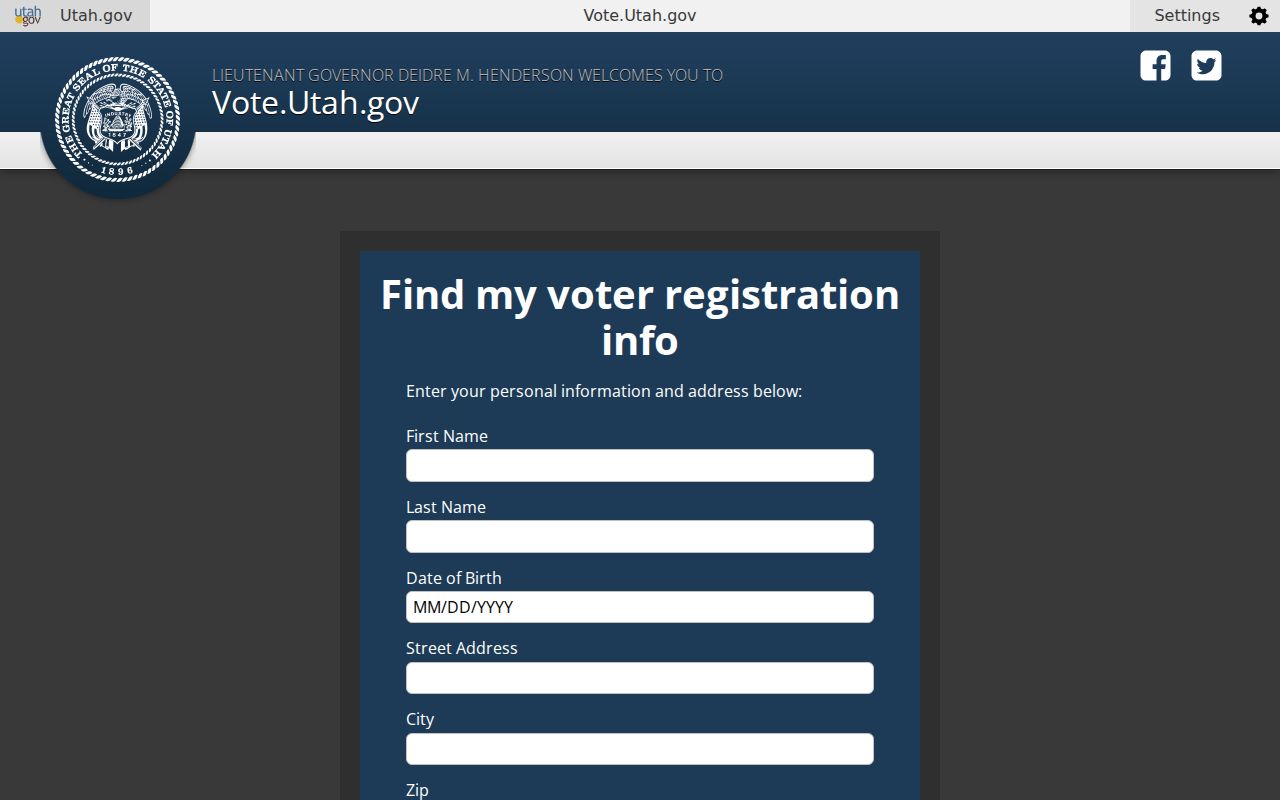
See the Utah voter self-lookup for the registration form fields.
Spanish Fork Court Search Has a Boundary
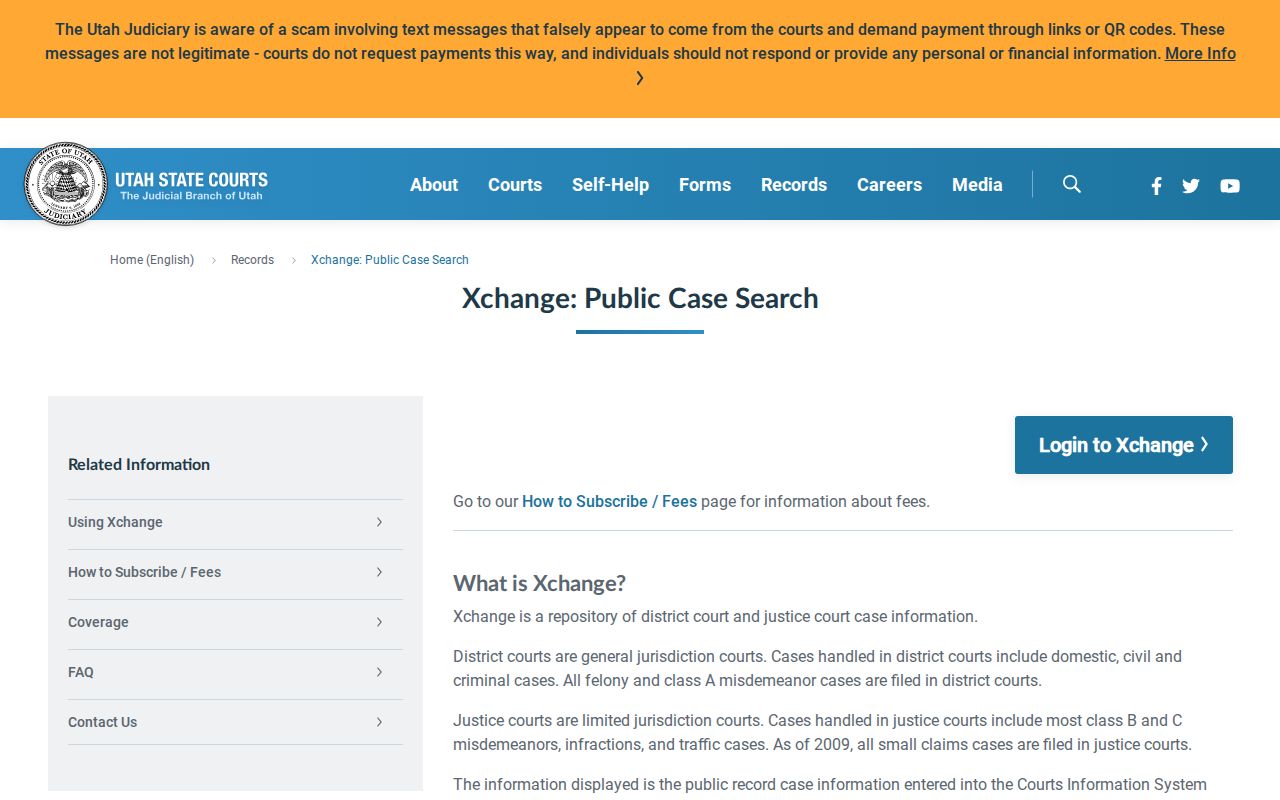
Utah State Courts Xchange covers district and justice cases. Spanish Fork is listed under the Fourth Judicial District, Spanish Fork Department, and the coverage page places Spanish Fork case coverage from March 2, 1998. Search controls include jurisdiction, search type, case number, last name or company, first name, case type, search scope, birth date, citation number, citation location, and an optional date-range panel.
A result can include county, court location, case type, case number, filing date, party names and codes, applicable birth date, case history, and document links. The case-type list includes civil, probate, domestic, criminal, traffic, lien or mortgage, small claims, and other categories. Xchange is billable. A guest account may have an initial charge, per-search and document fees, while a monthly account has setup and subscription costs. Confirm the current amount on the court page.
Sealed, adoption, civil-commitment, expunged, juvenile, child-welfare, termination, and some private civil records are excluded. Older justice-court dockets can require the Utah State Archives or a courthouse clerk. A no-result in Xchange is therefore a scoped result, not a universal statement about a person.
Spanish Fork Vital and Cemetery Leads
Recent Utah birth and death certificates go through the state Office of Vital Records and Statistics or Utah County Health. The county describes birth copies for 1931 to present and earlier Utah County birth records from 1905. County death records at the office are described from August 2006 to present, with earlier Utah County death records from 1905. The public windows are 100 years for birth, 50 years for death, and 75 years for marriage or divorce. Recent certified copies require the applicable relationship or direct, tangible, legitimate interest.
The Spanish Fork cemetery viewer searches Deceased, Mother, Father, and Owner. A result may show grave location, full name, parents, birth and death dates and places, burial date, owner, and an internal ID. The city page says the cemetery has its first burial in 1853, official establishment in 1868, 32 acres, and more than 12,000 headstones. It separately describes more than 2,000 database entries. Those are different measures and should remain separate until the cemetery office explains the coverage.
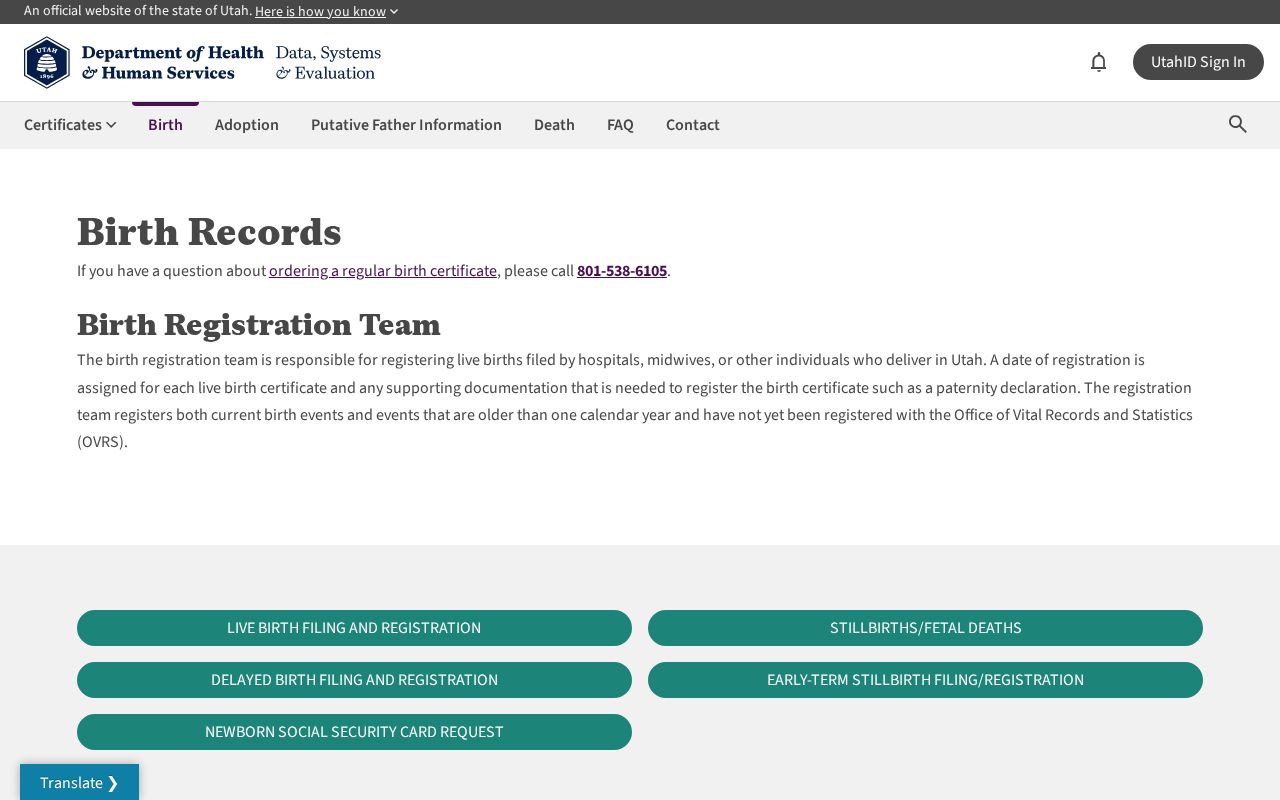
Use the Utah vital records office for the state certificate route.
The Provo Library Utah County Obituary Index has about 20,000 entries from the 1870s through 2007 and points to newspapers and burial material. Use an obituary as a finding aid. Confirm important dates with an archive image, cemetery record, or eligible certificate.
The Utah vital records page provides the state route for birth and death certificate research.
Spanish Fork 84660 Postal Clue
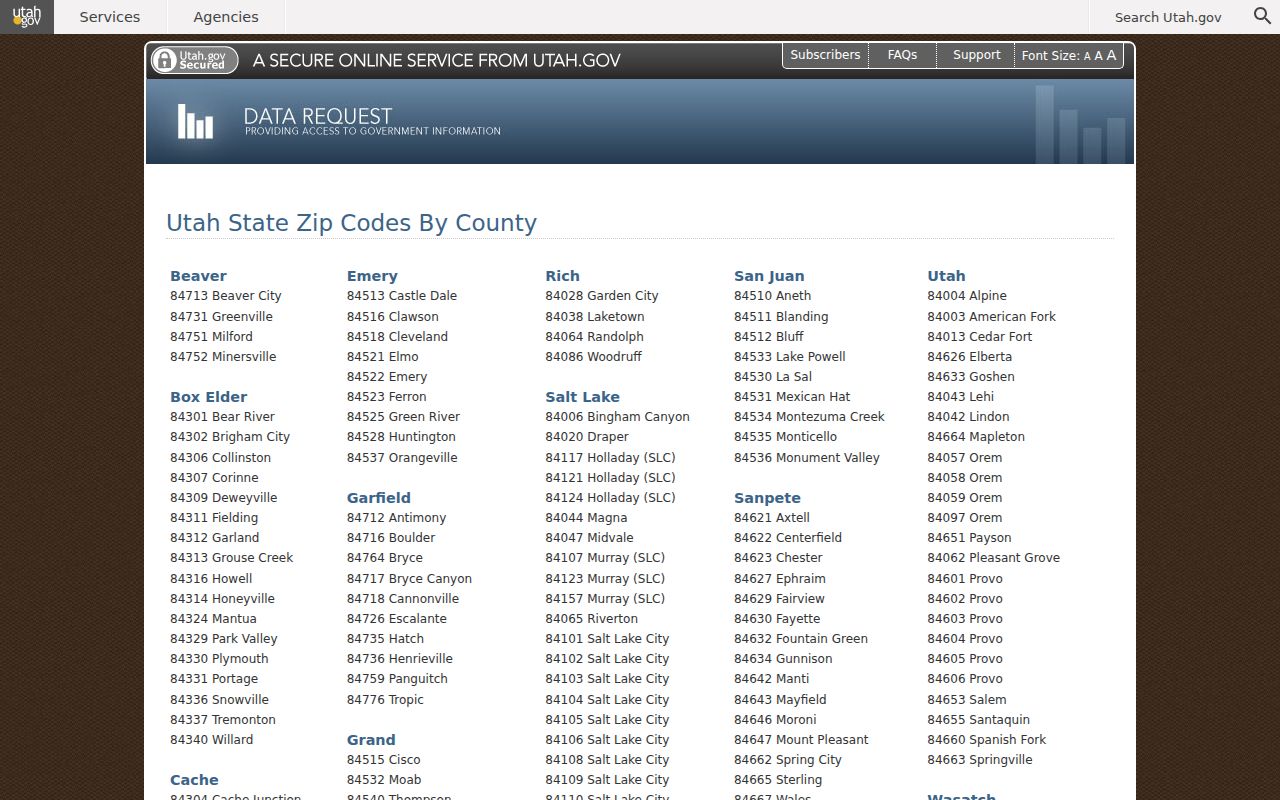
Utah’s official ZIP table associates Spanish Fork with 84660, and the USPS Spanish Fork Post Office is listed at 165 E 900 N. Postal geography does not draw the city line. Utah GIS says ZIP polygons approximate delivery areas. Nearby postal associations include Springville 84663, Payson 84651, Salem 84653, Santaquin 84655, Mapleton 84664, and several Provo ZIPs.
Use the ZIP as a sorting clue, then reconcile it with the county parcel’s SITE_ZIP5, the owner’s OWN_ZIP5, the city boundary layer, and the address itself. The ZIP code directory can narrow a search, but it cannot prove that a parcel was inside Spanish Fork during an older deed, directory, or newspaper event. Census ZCTA statistics are generalized statistical areas and should not be presented as exact 84660 city figures.
Check the Utah ZIP and city table for postal associations before treating a ZIP as a city boundary.
Spanish Fork Boundaries Changed
Spanish Fork’s identity has shifted with time. City history places Enoch Reece’s first home in 1850, a fort in 1854, and incorporation in January 1855. The 2005 city newsletter says Palmyra residents joined Spanish Fork in 1856, telegraph service arrived about 1867, and the Rocky Mountain Star was the first named newspaper in May 1891.
The annexation record starts with an 1872 boundary, a large de-annexation in 1899, another in 1904, smaller annexations in 1952, 1961, and 1964, later growth in the late 1960s and 1970s, and a 2007 map representing the current boundary. A historic source can therefore use Spanish Fork as a place label without describing the same modern municipal area.
Main Street adds a useful local map puzzle. The newsletter says it was first planned at 300 East and later moved west because of the railroad, with paving dated August 1920. When an old number does not fit a current map, use the legal description, plat, parcel serial, historic map, and document chain before assuming an error.
Spanish Fork’s Historical Shelf
The located R.L. Polk and Company Provo City and Utah County directory scan contains a Spanish Fork section on pages 241 through 252. The University of Utah City Directories Collection describes reference books arranged by residents, streets, businesses, organizations, and institutions. The exact continuous Spanish Fork run and every year are not yet confirmed. Treat the printed heading and page image as the authority for an entry, and use catalog metadata as a lead.
The Spanish Fork Library is at 80 S Main, with published hours Monday through Thursday 9 a.m. to 8 p.m., Friday 9 a.m. to 6 p.m., and Saturday 10 a.m. to 5 p.m. Its new catalog notice says users can search the collection and University of Utah historical photos. The library page does not name a local-history room, exact directory shelf, clipping file, or reverse-directory run. Ask staff for those holdings rather than assuming they exist.
The Utah County name index shows the name-led search that should be kept distinct from the historical shelf.
Utah Archives adds municipal records, including incorporation, ordinances, real-property files, deeds, planning, cemetery finance, and justice-court dockets. FamilySearch has a Utah County deed and mining catalog with indexes and images, subject to account or image restrictions.
The 1890 Spanish Fork Map Lead
Utah Archives’ Alex Bankhead feature identifies an 1890 Sanborn map showing property at the northwest corner of 300 South and 100 East in Spanish Fork. The same story points to Fourth District probate material from 1902 describing estate property and heirs, plus Spanish Fork tax-assessment-roll material from 1875 through 1879. This is a strong research lead because it joins map, court, and tax sources around one place.
The direct Sanborn image, complete probate series number, and current parcel crosswalk were not located. A careful search would identify the Archives series, inspect the assessment volume, compare the recorder abstract and legal description, then line up the historic map with current GIS. Keep confirmed facts and open questions in separate notes.
Spanish Fork Growth Records
Spanish Fork’s current growth changes how a recent address appears in a resident search. The city’s July 1, 2026 inventory lists 231 vacant single-family lots across named developments and lists multifamily vacancies at Juniper Ridge, Meadow Creek Ridge, Quiet Valley, River Run, and Escala. Those names are planning and development anchors, not a resident roster.
A new address may first appear in a final or preliminary plat, a permit, an assessor serial, a parcel layer, or a recorder document. Older city directories, newspapers, and obituaries may have no entry because the street or subdivision did not yet exist. The city says CitizenServe is the permit application route, but the public permit field set and historic migration coverage remain a research gap.
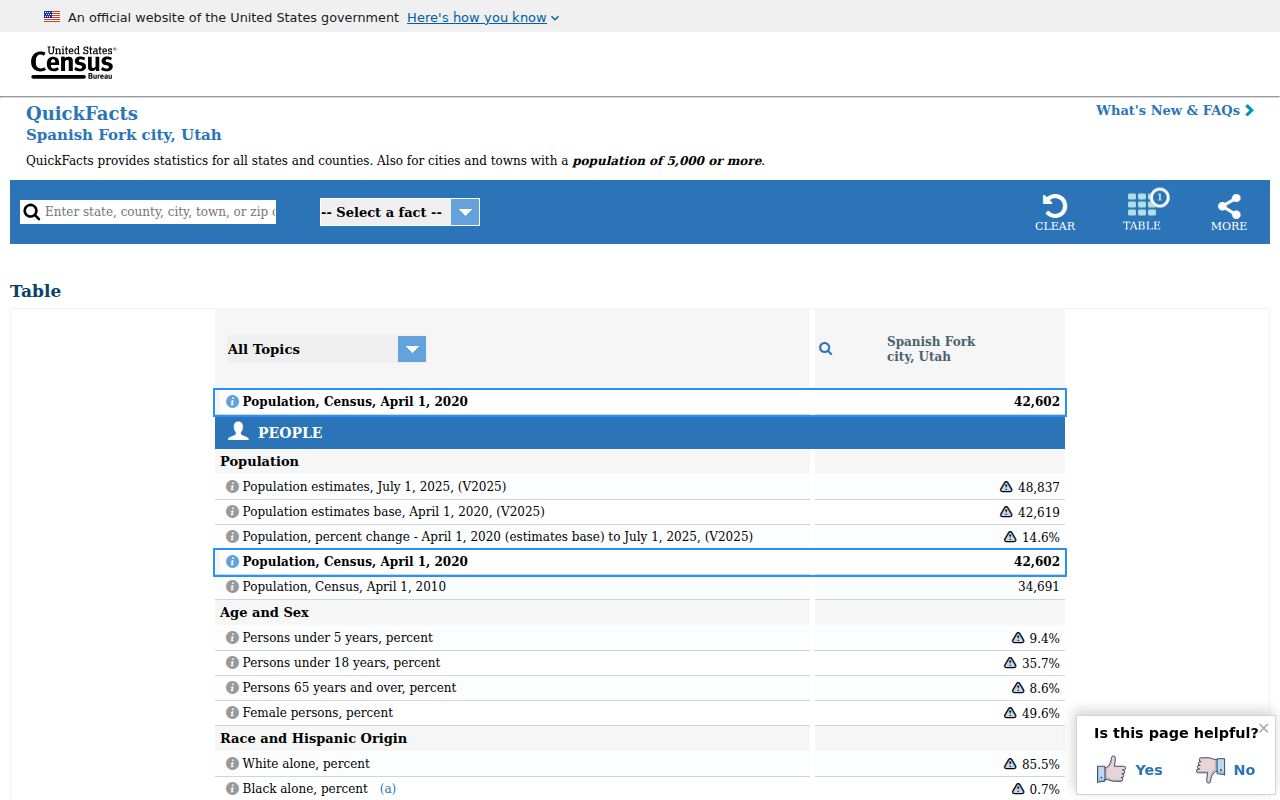
The Census QuickFacts Spanish Fork profile gives population and land context, not a named roll.
Read Every Match in Context
Use a positive match as a lead, then verify its identity, placement, substance, and date. A party name is not the same as an occupant. A parcel owner is not automatically a current resident. A booking is not a conviction. A cemetery entry is not a certified death record. An obituary is not a court or vital-record image. These distinctions keep the Spanish Fork residents directory useful without overstating what a public record says.
- Roll
- A recurring list maintained for a defined purpose, such as property assessment or voter registration.
- Index
- A finding aid that points to a record; it may not contain the full document or image.
- Parcel
- A mapped unit of land identified by a county serial and legal description.
- Criss-cross directory
- A reverse directory that starts with an address and points toward a name, often useful for past household research.
Lawful use. Spanish Fork and Utah records support personal, civic, legal, and family-history research. Do not use a record to stalk, harass, intimidate, expose a protected address, or bypass a privacy control.
Utah GRAMA requests go to the custodian under Title 63G, Chapter 2. A written request should name the requester, provide contact information if available, describe the record narrowly, and identify a date or parcel range. Inspection can be free, while copying or processing may cost actual expense. Records can be private, controlled, protected, restricted, sealed, redacted, not digitized, or outside a portal’s coverage.
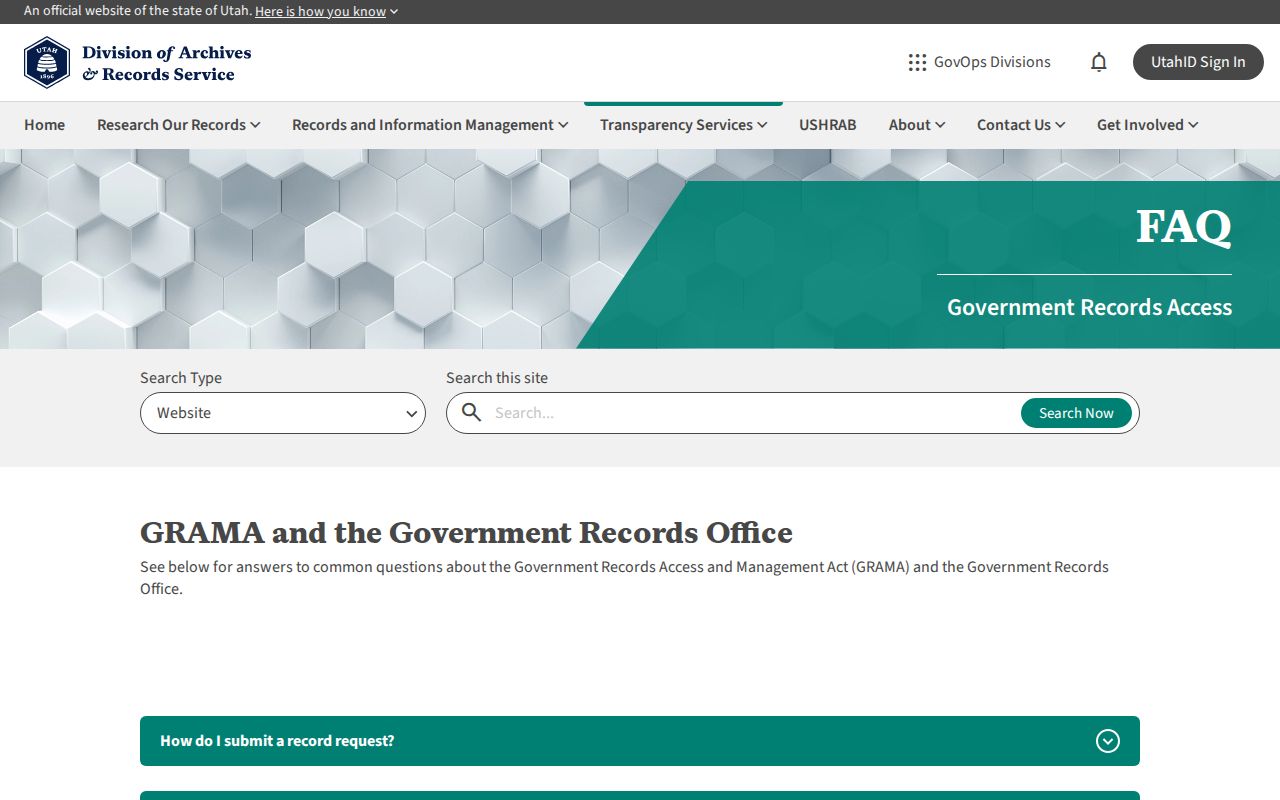
The Utah Archives GRAMA FAQ gives the written-request, inspection, fee, deadline, and appeal route.
Spanish Fork Source Log
A sound Spanish Fork residents directory search ends with a small evidence log. Write down the exact query, spelling or name variant, address form, source URL, query date, record number, and image or document link. For a negative result, state the scope and exclusions. For a positive result, retain the source document and a second confirming source when practical.
This practice matters because public systems change. Xchange result counts, county map layers, voter files, permit fields, fees, and cemetery entries can be updated or removed. The custodian remains the authority for a current or certified answer. Historical questions may need a library or archive reference request, especially when a city web page offers only a catalog lead.