
Spanish Fork ZIP Coverage
The official Utah ZIP and city table locates Spanish Fork with ZIP 84660. The USPS Spanish Fork Post Office is listed at 165 E 900 N, Spanish Fork. Nearby Utah County postal associations include Springville 84663, Payson 84651, Salem 84653, Santaquin 84655, Mapleton 84664, and Provo 84601 through 84606. These are postal-city labels, not a legal boundary set.
| ZIP | Areas Covered | Post Office or Label | Research Note |
|---|---|---|---|
| 84660 | Spanish Fork postal association | Spanish Fork Post Office | Use as a delivery clue; verify parcel and city line |
| 84663 | Springville postal association | Springville | Nearby does not mean inside Spanish Fork |
| 84651 | Payson postal association | Payson | Compare address and municipal boundary |
| 84653 | Salem postal association | Salem | Postal label is not annexation proof |
| 84655 / 84664 | Santaquin / Mapleton associations | Named postal cities | Use the state table for postal context |
The Utah ZIP table provides the postal association. It does not enumerate every delivery address or establish that a property lies inside Spanish Fork.
Find a ZIP-Linked Record
A ZIP code directory search should move from postal label to a record source that actually accepts or outputs ZIP data. Start by confirming the address in the USPS lookup. Its modes include address lookup, city and state lookup, and ZIP lookup. The Spanish Fork-specific result was dynamic in the research capture, so verify the actual address at access time.
- Write the postal ZIP and city label exactly as USPS or the state table returns it.
- Use the county parcel map to check the street, serial, site ZIP, city, and boundary layer.
- Keep SITE_ZIP5 separate from the owner’s OWN_ZIP5 when both appear.
- Choose a ZIP-capable source, such as the DOPL professional list or a business export, and save its date and filters.
- Reconcile the result to the parcel and Spanish Fork municipal boundary before calling it a local match.
Once a ZIP narrows the area to a street, the address-led Spanish Fork street directory route is more precise than a ZIP-wide label.
ZIP Fields in County Parcel Data
Utah County tax-parcel metadata uses separate fields for physical site and owner mail. SITE_STREET_NAME, SITE_STREET_TYPE, SITE_POST_DIR, SITE_STREET_UNIT, SITE_CITY, SITE_STATE, and SITE_ZIP5 describe where the parcel is. OWN_FULL_ADDRESS, OWN_STREET_ADDRESS, OWN_CITY, OWN_STATE, and OWN_ZIP5 describe where the owner receives mail. A mismatch is normal enough to document, not something to silently fix.
| SITE_ZIP5 | The ZIP associated with the parcel’s situs address. |
|---|---|
| OWN_ZIP5 | The ZIP in the owner mailing address. |
| ZCTA | A Census statistical approximation, not the USPS delivery area or city boundary. |
| Postal city | A USPS or state-table association that may cover land beyond the municipal line. |
This distinction is central to a Spanish Fork ZIP code directory. A record with 84660 in the owner mailing field does not by itself place the owner, parcel, or household inside Spanish Fork. A parcel with a Spanish Fork site address can have a different mailing ZIP.
Read the Utah County parcel metadata for the field definitions that keep situs and mailing geography apart.
ZIP Polygons Are Approximate
Utah GIS describes ZIP polygons as approximate delivery areas and says ZIPs are not legal geographic boundaries. The state page notes a February 2026 product update. Census ZCTAs are generalized statistical areas built for data use. Neither should replace a recorded plat, parcel geometry, annexation map, or legal description.
For historical research, a Spanish Fork ZIP code can also be absent because ZIP labels and municipal boundaries do not carry the same history. The city annexation page records an 1872 boundary, de-annexations in 1899 and 1904, later changes in 1952, 1961, and 1964, expansion in the late 1960s and 1970s, and a 2007 current-boundary map. A postal label cannot resolve those earlier questions.
DOPL Makes ZIP Filters Useful
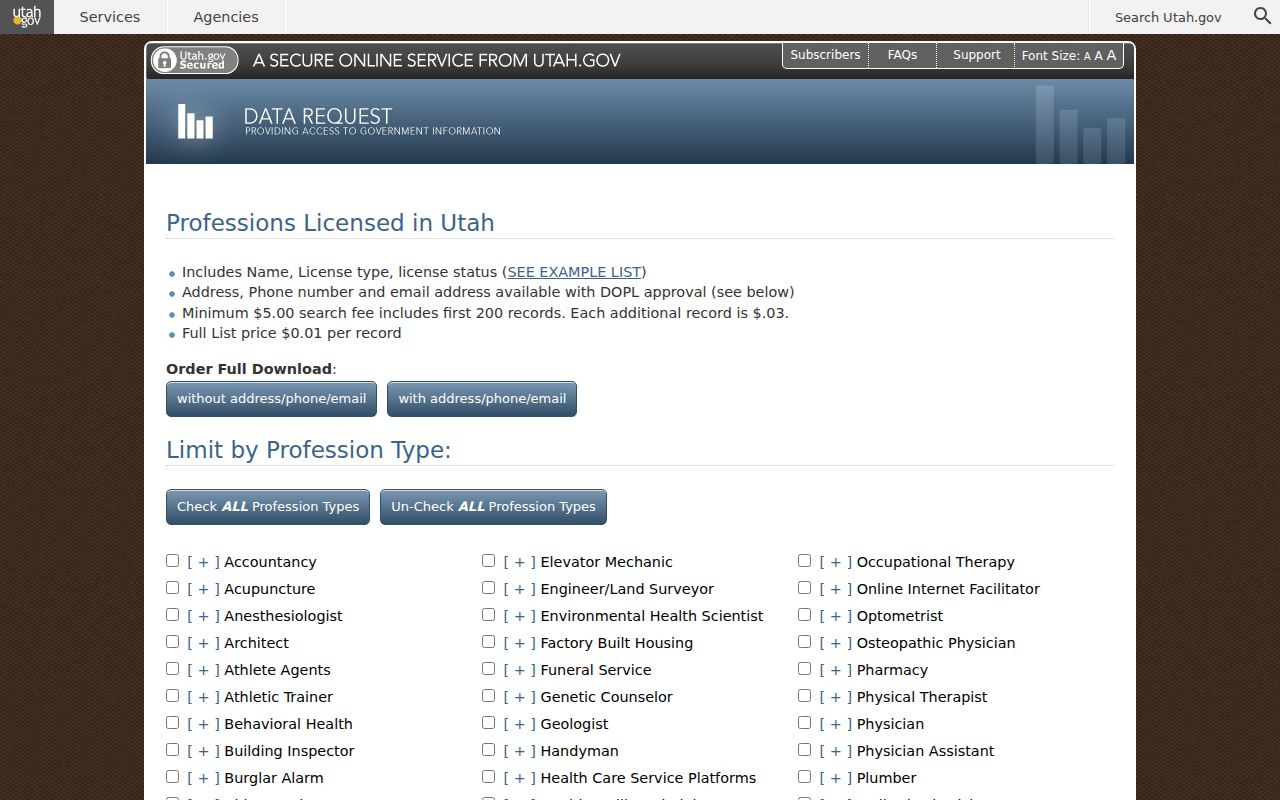
The Utah Division of Professional and Occupational Licensing professional list is one of the clearest public ZIP-capable portals found in the research. It offers profession checkboxes, comma-separated ZIP filters, license date after or before, update date after or before, expiration date after or before, entity type, and status. Entity type can be People, Organizations, or both. Status can be All, Active, or Expired.
| Profession | Categories include accountancy, architect, contractor, electrician, engineer or land surveyor, funeral service, health professions, plumber, psychologist, security, and veterinarian. |
|---|---|
| ZIP | One or more ZIPs separated by commas. |
| Date filters | License, update, and expiration dates before or after a selected date. |
| Output | Profession, name, license type or number, status, dates, and address fields when allowed. |
The research gives a minimum fee of $5 for the first 200 records, $0.03 for each additional record, and $0.01 per record for a full list. Confirm the current fee. Address and phone may be exempt under Utah law, and a professional record is not proof of residence.
Business ZIP Output Has Limits
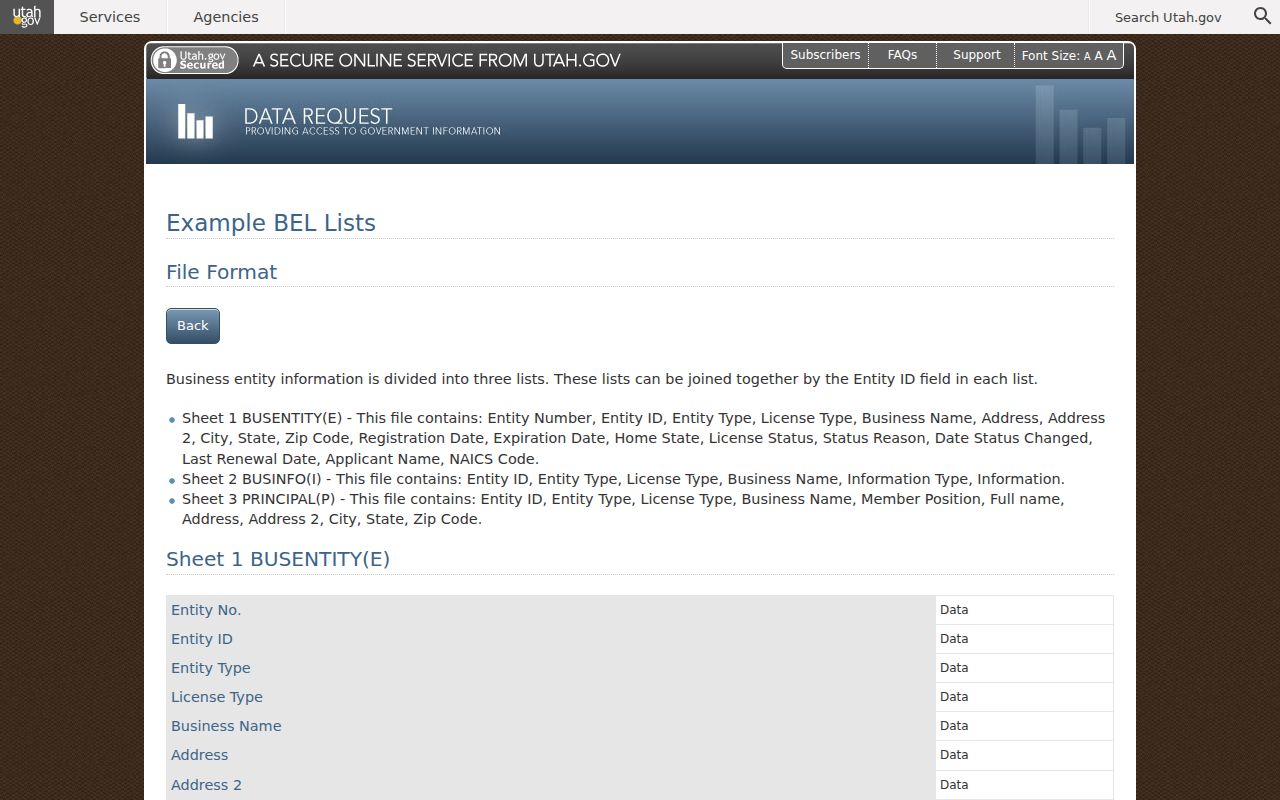
Utah Commerce entity-list output can contain business number, entity ID, entity type, license type, business name, address, city, state, ZIP, registration and expiration, status, status reason, status-change date, renewal, applicant, and NAICS. A PRINCIPAL section can contain member position, full name, and address. The search is for a business record.
Use a business ZIP result to understand an entity connected to Spanish Fork, not to label a principal as a resident. Filings may be instant while other requests take 2 to 4 business days. The city business-license page describes commercial, home-occupation, temporary or itinerant, and solicitor licenses but does not expose a searchable public register. A defined request to the city recorder is the fallback.
Inspect the Utah business list example before interpreting a ZIP-linked entity row.
Other ZIP Research Routes
Utah voter data can include residence, county, precinct, and ZIP in some election files, but the self-lookup is for an individual’s registration check. A who-has-voted file is limited to specified even-year elections and time windows, with price and privacy exclusions. It is not a complete current-resident list. The unclaimed-property search asks for last or business name and first name, with optional city and ZIP, but a match is only a possible claim lead.
Professional, business, tax-parcel, voter, and unclaimed-property results all need their own labels. Save the source, filters, date, and output fields. Do not merge them into a single resident conclusion. The ZIP code directory is a geographic index, not a substitute for a custodian’s record classification.
ZIP and City Limits Diverge
84660 is the Spanish Fork postal association, but it is not an annexation map. An address can carry a Spanish Fork mailing label while a historic record uses a county or earlier community name. Conversely, a nearby postal city can be the delivery label for a place that readers think of as part of the Spanish Fork area. Check the county GIS city layer, the city annexation history, the parcel legal description, and the record date.
Boundary check. Label each result as postal, situs, owner mailing, municipal, county, or ZCTA geography. Those terms are not interchangeable.
The city general plan also separates an annexation policy boundary from a growth-management boundary. A planning boundary describes future or managed growth, not a current parcel’s postal or municipal identity.
Keep ZIP Results Lawful
A ZIP filter can narrow a civic or family-history search, but it cannot reveal protected details. Utah voter privacy routes can withhold at-risk addresses. Safe at Home uses a substitute address and keeps the actual address confidential. Do not combine ZIP, voter, business, or parcel results to defeat a privacy control or expose a person’s location.
Lawful use. Use Spanish Fork ZIP data for personal, civic, legal, property, or historical research. Do not use a result to stalk, harass, intimidate, or repeatedly contact a person.
When a ZIP result matters, confirm it with the proper custodian. A current address question belongs with the parcel and address source. A historical question may belong with a directory, deed, newspaper, or archive. A statistical question belongs with Census geography labeled as such.